Why Your AI Meal Plans Get Repetitive by Week Two (And the Fix)
Chicken again. Four reasons the same meals keep coming back, three of which are things you control, and what to change in the prompt for each.
Meal Planning
AI meal planning with ChatGPT: one prompt, once a week, for seven dinners and the shopping list to buy them. About 15 minutes, on the free tier.
Updated
One prompt in ChatGPT, answered once a week, gives you seven dinners and the shopping list to buy them. It takes about 15 minutes, it works on the free tier, and nothing gets installed or connected to anything.
Below is the whole system: the prompt itself, the three things it gets wrong every single time, how the shopping list falls out of the plan without retyping anything, and what to do the week none of it survives.
It is a way of doing the deciding in one sitting instead of seven. That is the whole benefit, and it is bigger than it sounds. The tiredness at five o’clock is rarely about the cooking. It is about the choosing. If you have never done this before, the first week step by step is the slower walkthrough of the same thing.
You describe your week — how many people, how many nights you actually cook, what everyone will and will not eat — and you get a plan back. You cross out what will not work, ask for replacements, then ask for the shopping list. That is the entire loop.
It does not know what is in your cupboards, so it will send you out for things you already own. It does not know your family, so a couple of dinners in seven will be wrong the first week and fewer after that. And it cannot tell you whether a food is safe for an allergy — it will answer in a confident voice with no way to check what it said.
None of that makes it useless. It makes it a first draft, which is what you want on a Sunday afternoon: something to edit rather than something to invent.
Every prompt here is run on the free tier of the tool named, with the kind of messy input a real week produces, before it goes up. Each one carries the month it was last checked. When a model changes underneath us and a prompt stops behaving, it gets fixed here rather than left to rot. The full method is on the about page.
Sit down once a week somewhere you will not be interrupted for a quarter of an hour. The first two steps are the deciding. The last one is the shopping list, and the shopping list is where the money is. If you would rather have it timed minute by minute, the week-by-week walkthrough is the same method against a stopwatch.
How many people, how many nights you actually cook, and the foods that start an argument. Four people, five cooking nights, nothing with fish is enough detail.
Read the seven lines, say what is wrong in a few words, and ask for replacements. This is the step that makes the plan yours rather than the model’s.
One more message turns the plan you just approved into a list grouped by aisle. This is the artifact you take to the shop.
Fill in the brackets and send it. Leave the brackets in when you copy — they are the instruction, and the model reads them as one. If you want to know why each line is in there before you use it, the prompt is taken apart line by line here.
Tested with free ChatGPT · August 2026
The first pass is never the plan. Three corrections cover almost all of it:
Say all three in one message rather than three separate ones: “Five nights, not seven. Nothing that needs an ingredient I would only use once. At least two of them under 20 minutes.” It rewrites the week in one go.
Four people, five cooking nights, a tight budget, and a child who will not eat anything mixed together. Five nights in, five dinners out — five different main proteins, every line noting how to keep the child’s portion separate, and two carrying a shortcut for the evenings that fall apart.
Nothing here was corrected.
A plan that produces one shopping trip instead of four is the difference between a week that costs what it should and one that quietly does not. The list is not a second job. It comes out of the plan you already have.
Tested with free ChatGPT · August 2026
Two lines in that prompt do the real work. Grouping by aisle means you walk the shop once instead of doubling back. The star on single-use ingredients is the waste mechanism — it turns the expensive decisions into a short list you can look at before you leave the house. That star and the CHECK FIRST section are what people mean by cooking down the pantry. All four lines are pulled apart, with what each one prevents, in the longer version of the list prompt.
The plan is rarely what fails. What fails is standing in the shop adding things to the trolley. Take the list on your phone, buy what is on it, and leave. The CHECK FIRST section exists so you look in your own cupboards before you go, rather than after you get back with a second jar of paprika. If the cupboard is where you want to start rather than end, the pantry audit builds the week from what is already in the house.
Ask it. “I have half a cabbage, three eggs, and some rice. Dinner for two, nothing else bought.” This is the thing it is best at, because there is no guessing involved — you have told it exactly what exists. The fridge clean-out prompt is that same job written out, with the four things a leftover usually becomes.
Constraints make these tools better, not worse. An open question gets an open answer. A budget, a headcount, and a list of what is already in the cupboard get you something you can actually shop.
It does not know what your supermarket charges, and any total it gives you is a guess wearing the clothes of a figure. Ignore the totals. What it is genuinely good for is the shape of the spend: ask which three items on the list are doing the least work for their price, and it will tell you. Then you decide. Where the money actually goes in a week for four has the proportions, and the capped grocery week puts a hard number in the prompt.
Cheap and unfamiliar at the same time is how a budget week fails. Ask for swaps that keep the shape of a meal everyone already recognises — the same dinner with a cheaper middle. Lentils in a bolognese nobody was told about is a swap. A lentil bake announced at the table is a negotiation.
This is where planning by hand gets genuinely hard, and where the time saved is largest. One household with a coeliac, a vegetarian, and a five-year-old with opinions is exactly the problem a well-written prompt handles well.
Put every constraint in the first message rather than correcting them one at a time. “No gluten, one vegetarian out of four, nothing spicy.” Constraints given up front shape the whole plan. Constraints added afterwards produce a plan with holes patched into it, and the patches are where the bad dinners live.
Stop planning two dinners. Ask for meals built from a plain component plus something that goes on at the table — the same pasta, the same rice, the same chicken, finished two ways. One pan, one plan, and the argument moves off the stove and onto a bowl of grated cheese. The four accommodations that make dinner workable covers the rest of it, including the one that is about the adults.
The calorie and macro figures are the least reliable thing it gives you. Ask for a week of dinners and you get dinners. Ask for the nutrition breakdown and you get numbers in exactly the same confident voice, checked against nothing.
A registered dietitian who tested this for TODAY found it genuinely useful for meal ideas and short of the mark for anything measured. The figures are produced the same way the dinner suggestions are — fine for a dinner suggestion, and not fine for a number you are going to act on. Asking for protein per meal rather than per day is the version that stays checkable.
Treat them the way you should treat the cost totals further up this page: the shape of a thing, not the thing. If you need the number, it is on the packet.
This plans dinners. It does not manage a medical condition, and the distance between those two jobs is wider than it looks from the outside.
Weight loss, diabetes, blood pressure, anything where food is part of a treatment — that is a person’s job, and nutritionists quoted in Outside have been blunt about why. Nobody can walk you through the nuance of your own body from a prompt.
None of which stops it being useful for what this page is about. Deciding what is for dinner is not a medical question, and not a substitute for one.
Ask for the week to be arranged around one cooking session rather than seven, and it will restructure the whole thing to do it. Same dinners, different order, with the chopping and the roasting pulled forward into a block.
Sixty minutes buys you components, not finished meals: a tray of roasted vegetables, a pot of grains, one cooked protein, one sauce. Four things that become five dinners in about ten minutes each. Ask for the plan in that shape and it will write you the session as well as the week. The 90-minute session is the timed version, and the freezer starter kit is what to do with the surplus.
Most weeks there is no hour. Ask instead for two dinners that deliberately make too much, and have it name the second meal each one turns into. Cooking twice as much once is not meal prep, and it works on a Tuesday, which meal prep does not. And on the nights with no plan at all, the five o’clock prompt is four lines and a decision.
Every system on this site fails the same way, and it is never week one. It is week three, when the novelty has gone and the process is still a process.
Fifteen minutes on its own does not survive. Fifteen minutes attached to something already in your Sunday — the wash going on, the coffee after lunch, the shop you were doing anyway — does. Pick the thing to attach it to, not the time to do it at. Once it is a habit, a two-week rotation turns the fifteen minutes into about two.
The other thing that goes wrong is not you. It is the plan. Four reasons the plans repeat, three of which you control.
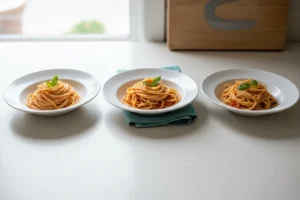
By the second or third week the same dinners start coming back. A stir-fry three weeks running. Rice bowls that have quietly stopped being different from one another. This is not the model getting lazy — it is the model starting from nothing every time. It does not remember last week, so it has no reason to avoid repeating it.
So stop giving it a blank page. Paste last week’s dinners in above the prompt with one line: none of these, and nothing that is basically one of these.
It will collapse. Somebody gets ill, the week turns, and by Wednesday there is a takeaway on the table and the plan is a piece of paper under a bill. The move is not to start again from nothing. It is to keep the running list of dinners that worked, and start the next Sunday from that list instead of from a blank prompt.
That list — the 20 or so meals your household actually eats — is the thing worth having. The plan is a week. The list is a year.
Dinner is one of two decisions that quietly eat a Sunday. If the other one is the week itself, the ten-minute reset is this same method applied to everything that is not food.
Yes, for everything on this page. ChatGPT’s free tier will plan a week and write a shopping list without a subscription, and none of the prompts here need a paid feature — the same is true of the other major assistants. Paid plans are faster and remember more between sessions. Neither is required to do this.
Then the first pass did its job, which is to give you something to react to rather than a blank page. Say what was wrong in a few words — too much rice, nobody eats fish, the Tuesday one takes too long — and ask for replacements. It takes seconds, and next week starts closer to right because you can paste the same corrections in at the top.
The first Sunday is the slow one, because you are describing your household to it for the first time. After that you are pasting a prompt you have already written and reading a short list, which is a much smaller job than deciding seven dinners from nothing.
No, and a full inventory would waste the time you are trying to save. Naming three or four things you want used up is enough — the half bag of spinach, the mince in the freezer — and it will build the week around them. The rest it can assume. Those three or four lines do more work than they look like they do: they are what stops the plan sending you out for a second jar of paprika, and what keeps single-use ingredients off the list.
It can avoid an ingredient. It cannot confirm that a food is safe, and those are different jobs. It will answer a safety question in the same confident voice it uses for everything else, with no way to check. Use it to generate options that avoid the ingredient, and check every label yourself.
Not as numbers. It will give you calorie counts and macro breakdowns in the same confident voice it uses for everything else, and they have not been checked against anything. Dietitians who have tested it find it useful for meal ideas and unreliable for measurement. Use it to decide what to cook, and use a packet — or a person — for anything you are going to act on.
Chicken again. Four reasons the same meals keep coming back, three of which are things you control, and what to change in the prompt for each.
The constraint on an activity night is never the cooking. It is the twenty minutes between coming in and going back out, and four dinner shapes survive it.
Four accommodations that make dinner workable, and the one that is about the adults rather than the child. Plus the prompt that builds a week around them.
If you have never used AI before, the starter path takes fifteen minutes and assumes nothing.