Plan a Week of Dinners in 15 Minutes with ChatGPT
What’s in this guide
Fifteen minutes, once a week, and the dinner question is answered until next Sunday. Three minutes describing your week, five reading what comes back and saying what’s wrong with it, four turning the survivors into a shopping list, three putting it somewhere you’ll actually see it. Free tier, no app, nothing to install.
Below is each of those blocks, in order, with what to do and roughly how long it takes. The first week runs longer — that’s covered too.
If you want the reasoning behind the method rather than the stopwatch version, the full beginner’s meal planning guide has it. This page is the doing.
Before you start: 30 seconds of setup
Open ChatGPT — the free tier is fine and signed-out works. Have somewhere to put the finished list: a note on your phone, the fridge, the printable at the end of this page. That’s it. You don’t need an account with anything, an inventory of your cupboards, or a plan for what you’re doing.
Pick a moment that already exists in your Sunday rather than a time on a clock. The wash going on, the coffee after lunch, the ten minutes before anyone else is up. Fifteen minutes attached to something that already happens survives. Fifteen minutes at half past four does not.
Minutes 0 to 3 — describe the week
Paste this in and fill in the brackets. Leave the brackets themselves in place.
Tested with free ChatGPT · August 2026
Three minutes is genuinely enough. You’re describing a household you already know — how many of you there are, which evenings you cook, what starts arguments. There’s no research step.
Why each line is in there, and how to write your own version of this prompt for other jobs, is in our complete AI meal planning system and the prompt breakdown it links to.
Minutes 3 to 8 — read it and say what’s wrong
This is the longest block and the one that matters. What comes back is a draft. Your job is to react to it, which is a much smaller job than inventing seven dinners from nothing — and that difference is the entire point of doing it this way.
Read the list once, quickly
Don’t evaluate as you go. Read all of them, then decide. Going line by line makes you negotiate with each dinner separately and turns five minutes into fifteen.
Say everything wrong in one message
Not three messages. One. Something like: Nothing with fish. Tuesday needs to be under 20 minutes. Swap the risotto, nobody will eat it.
It rewrites the whole week in one go, and the rewrite accounts for all three corrections together rather than patching them in one at a time. Patched plans have holes in them, and the holes are where the bad dinners live.
Two rounds, then stop
A third round of corrections almost never improves the week. It just moves the disappointment somewhere else. If two dinners are still wrong after two rounds, keep the five that work and decide those two on the night — which is what you were doing before, for all seven.
Minutes 8 to 12 — turn it into a list
You approved a plan. Now get the artefact you actually carry around.
Tested with free ChatGPT · August 2026
Read the starred items before you leave the house. Each one is a thing you’re buying for a single meal, and that’s where a sensible week quietly turns expensive. Sometimes the answer is buy it anyway. Sometimes it’s swap that dinner. The star just makes it a decision instead of a surprise at the till.
The CHECK FIRST section is the other half of that. Look in your own cupboards before you go, rather than after you get back with a second jar of paprika.
Minutes 12 to 15 — put it where you’ll see it
The step everyone skips, and the reason week three fails.
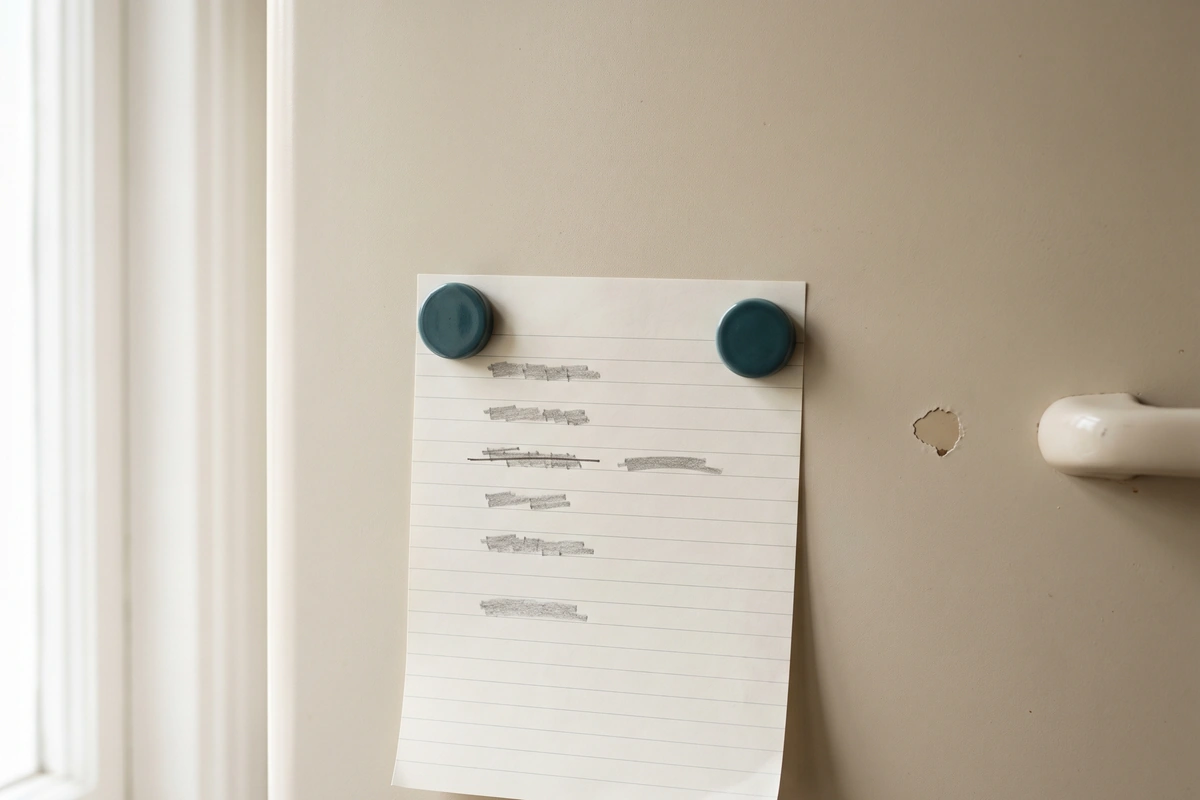
A plan that lives in a chat window is a plan you have to go and find at five o’clock, which means you won’t. It needs to be somewhere passive — on the fridge, on the printable, screenshotted to your phone’s lock screen, whatever you’ll walk past.
Use the last of the fifteen minutes for two things:
- Write the seven lines somewhere visible. Not the recipes. The seven lines.
- Save your filled-in prompt. A note on your phone is enough. Next Sunday is a paste, not a decision, and that’s what makes this fifteen minutes instead of thirty.
What the first pass looked like
This is the end of minute three, before any correcting. Five nights in, five dinners out, named by day and timed — Monday mince spaghetti at 25 minutes through to Sunday chickpea curry at 30.
The two carrying a faster version line are Tuesday and Sunday: skip the peas and carrots for egg-and-rice in about ten minutes, skip peeling the potatoes for chickpeas and rice under twenty. Those two lines are what minutes 3 to 8 are for.
The first week takes longer, and that’s the whole cost
Budget 25 minutes the first time. You’re describing your household to something that has never met it, and you’ll rewrite the constraints twice before they say what you meant.
Week two is the real number, because the describing is done. You paste the prompt you saved, read seven lines, correct one or two, take the list. The work went into writing your household down once — and it stays written down.
Keep the corrections. Whatever you had to fix this week, paste it into next week’s prompt and the first pass arrives closer to right. After a month there’s usually nothing to correct. The model hasn’t improved. Your description has.
When you haven’t got 15 minutes
Some Sundays there isn’t a quarter of an hour, and the honest answer isn’t to find one. It’s to do a smaller version, because five minutes of planning beats fifteen minutes you skipped.
The five-minute version
Paste your saved prompt, change the number of nights if it’s different, send it. Take whatever comes back. Correct nothing. Ask for the list. For a night with no plan at all rather than a rushed one, the five o’clock prompt is a different job in four lines.
Two of the dinners will be wrong and you’ll deal with them on the night, the way you were dealing with all seven before you started. You’ve still removed five decisions from your week for five minutes of work.
The two-minute version
Open last week’s plan. Cross off the two nobody liked. Ask for two replacements and a list for the whole week.
This is better than it sounds and worse than it looks. Better, because a week made of dinners that already worked has a high floor. Worse, because doing it four weeks running is how you end up eating the same six meals — so use it for the weeks that need it, not as the method.
The week you skip entirely
You’ll miss one. Somebody gets ill, the week turns, and by Wednesday there’s a takeaway on the table and no plan anywhere. And when it is not a missed week but the same six dinners over and over, that has four causes and three of them are yours.
Don’t restart from nothing next Sunday. Restarting from nothing is what makes a missed week feel like a failed system, and it’s why most people stop at week four. Open the last plan that worked, paste it in, ask for a week like that one. You’re back in about three minutes.
The printable
The Weekly Dinner Planner is one sheet: seven lines for the dinners, a column for what needs buying, and the prompt cards on the back so you’re not looking this page up again. Print it, stick it on the fridge, fill it in during minutes 12 to 15.
It’s free and there’s no catch worth writing a sentence about.
Questions about the 15-minute weekly plan
Is 15 minutes realistic?
From week two, yes, and the breakdown above is where it goes: three minutes describing, five reading and correcting, four on the list, three writing it somewhere visible. The first week runs closer to 25 because you are describing your household for the first time. That describing is a one-off, which is why week two is so much shorter.
Do I need to pay for ChatGPT?
No. Everything on this page runs on the free tier, and neither prompt uses a paid feature. Paid plans are faster and remember more between sessions, which is convenient and not required. The tested date on each prompt box says when we last checked it.
What if I do not know which nights I am cooking?
Say so in the prompt, in those words. It will stop assigning meals to particular weekdays and give you a pool to pick from instead. That is usually the better version anyway, because a plan that names Tuesday is a plan you can fail on Tuesday.
Do I have to tell it what is in my cupboards?
No, and a full inventory would waste the time you are trying to save. Three or four things you want used up is enough — the half bag of spinach, the mince in the freezer. It builds the week around them and assumes the rest.
What happens the week it all falls apart?
It will, usually around week three when the novelty has gone. Do not start again from nothing. Keep the running list of dinners that actually worked and start the next Sunday from that list instead of a blank prompt. The plan is a week. The list is a year.
Keep going
-

Why Your AI Meal Plans Get Repetitive by Week Two (And the Fix)
Chicken again. Four reasons the same meals keep coming back, three of which are things you control, and what to change in the prompt for each.
-
Back-to-School Dinner Sprint: 20-Minute Meals for Activity Nights
The constraint on an activity night is never the cooking. It is the twenty minutes between coming in and going back out, and four dinner shapes survive it.
-
AI Meal Plans for Picky Eaters (The Rotation That Ends Dinner Fights)
Four accommodations that make dinner workable, and the one that is about the adults rather than the child. Plus the prompt that builds a week around them.