30 Pantry-Staple Dinner Ideas (AI-Generated, Human-Tested)
What’s in this guide
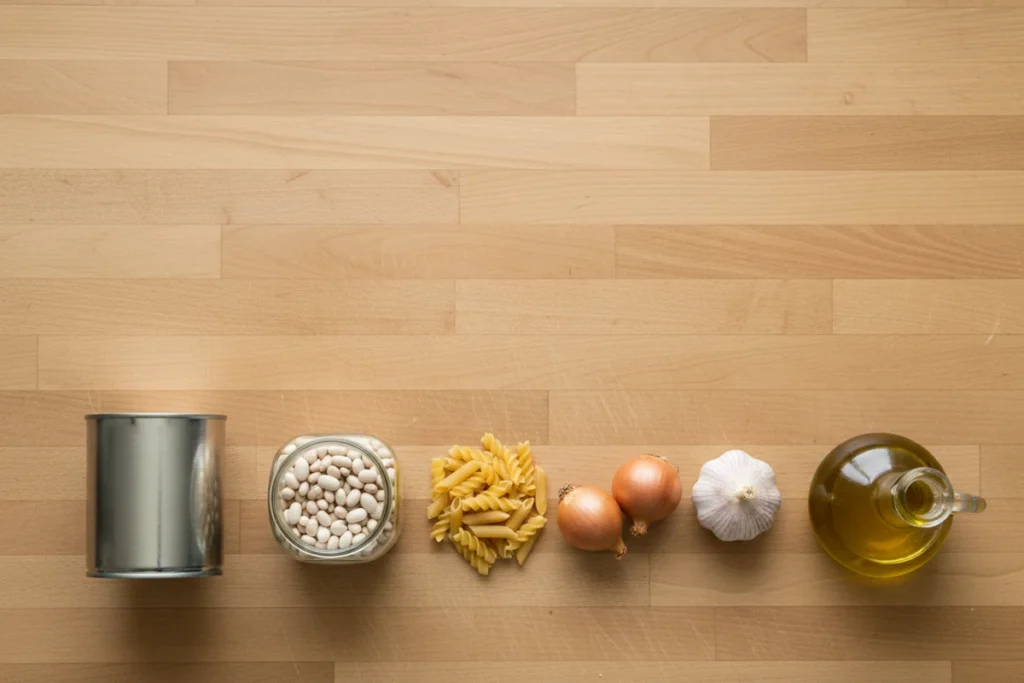
Thirty dinners sounds like a lot to hold in your head. It is not, because they are not thirty separate things — they are four bases with variations hung off them, and once you can see that, restocking a cupboard becomes a much simpler decision than choosing a recipe.
Below is the shape of the thirty, then the prompt that produces your own version. Yours will be better than a generic list, because it is built from the shelf you actually have.
The four bases, and what each is for
Pasta and noodles — about twelve of the thirty
The cheapest base per portion and the fastest to the table. Its weakness is that it is the default, which is exactly why pasta is what people mean when they say their meals have got repetitive. It carries tinned tomato, tinned fish, beans, frozen peas, an egg, and almost anything in the sad drawer.
Rice and grains — about nine
Slower, and worth it because rice takes on flavour rather than sitting beside it. This is where a tin of coconut milk or a handful of spices does the most work. Cooked rice is also the best leftover in the kitchen, which makes this base worth twice what it looks.
Tins — about six
Beans and tomatoes doing most of the work, with tinned fish behind them. These are the dinners that need nothing fresh at all, which makes them the genuine bottom of the barrel — the ones still available on the night you have not shopped in nine days.
Eggs — about three
The fastest dinner in the house and the most underrated. An omelette, a frittata with whatever is going soft in it, or eggs on rice. Ten minutes, and it is the answer on the nights when nothing else is.
Getting your own thirty
A generic list of thirty dinners has one flaw: about half of it needs something you do not keep. Building the list from your own shelf removes that entirely, and takes about a minute.
What to do with the list once you have it
Do not try to cook from it. Thirty options is a paralysis, not a plan — that is the same problem as an open fridge, in a longer format.
It is a reference for two specific moments. First, when a week needs filling and you want to pick five from a list rather than invent five from nothing. Second, and more valuable, when you are deciding what to restock.
Reading it backwards, which is the actual trick
Look at which items appear in the most dinners. Usually it is tinned tomatoes, an onion, and something like frozen peas — three cheap things propping up a third of the list.
Those are what you never let run out. Everything else on the shelf is optional, and knowing which is which is worth more than the thirty dinners are.
The ones that will not be good
Some of your thirty will be dull. That is not a failure of the prompt — a list of thirty dinners built from cupboard staples contains some dull dinners, and a version that claimed otherwise would be lying to you.
Cook the promising ones first and mark what worked. After a month you will have perhaps twelve that are genuinely in the rotation, which is a substantial fortnight and more than most households can name off the top of their heads. That set feeds straight into a two-week rotation.
The rest can go. A list of thirty that produced twelve keepers has done its job.
The printable
The Weekly Dinner Planner has room to note which of these actually got eaten, which is how a list of thirty ideas turns into a list of twelve dinners that work in your house.
Questions about pantry-staple dinners
Why build my own list instead of using a published one?
Because about half of any generic list needs something you do not keep in, and you find that out at the hob. A list built from your own shelf has no dead entries. It takes about a minute to generate and it is the difference between a reference you use and one you read once.
Are thirty dinners not too many to keep track of?
They are, which is why the list is a reference rather than a plan. Its two real uses are filling a week by picking rather than inventing, and telling you which three or four cheap items are propping up a third of your options.
What are the most useful things to keep in?
Generate your list and count which items appear most often. In most households it is tinned tomatoes, onions and something frozen like peas. Those are the ones worth never running out of; the rest of the shelf is genuinely optional.
Will some of the thirty be bad?
Yes. A list of thirty cupboard dinners contains some dull ones, and a version that claimed otherwise would be overselling. Cook the promising ones first, mark what worked, and expect around twelve keepers after a month.
Does this work with a small kitchen or limited storage?
Yes, and arguably better. Fewer staples means the list leans harder on the four bases, which is where the cheap and fast dinners already are. Say what storage you have in the prompt and it will keep the list inside it.
Keep going
-
Why Your AI Meal Plans Get Repetitive by Week Two (And the Fix)
Chicken again. Four reasons the same meals keep coming back, three of which are things you control, and what to change in the prompt for each.
-
Back-to-School Dinner Sprint: 20-Minute Meals for Activity Nights
The constraint on an activity night is never the cooking. It is the twenty minutes between coming in and going back out, and four dinner shapes survive it.
-
AI Meal Plans for Picky Eaters (The Rotation That Ends Dinner Fights)
Four accommodations that make dinner workable, and the one that is about the adults rather than the child. Plus the prompt that builds a week around them.