The Lunchbox System: A Week of Kids’ Lunches in 20 Minutes
What’s in this guide
The problem with packed lunches is not making them. It is deciding what goes in them, five days a week, at ten past seven, while other things are happening.
A formula removes the deciding. Four slots, filled in the same order every time, with a small set of options for each. The morning becomes assembly, which anybody can do half asleep.
The four slots
The anchor
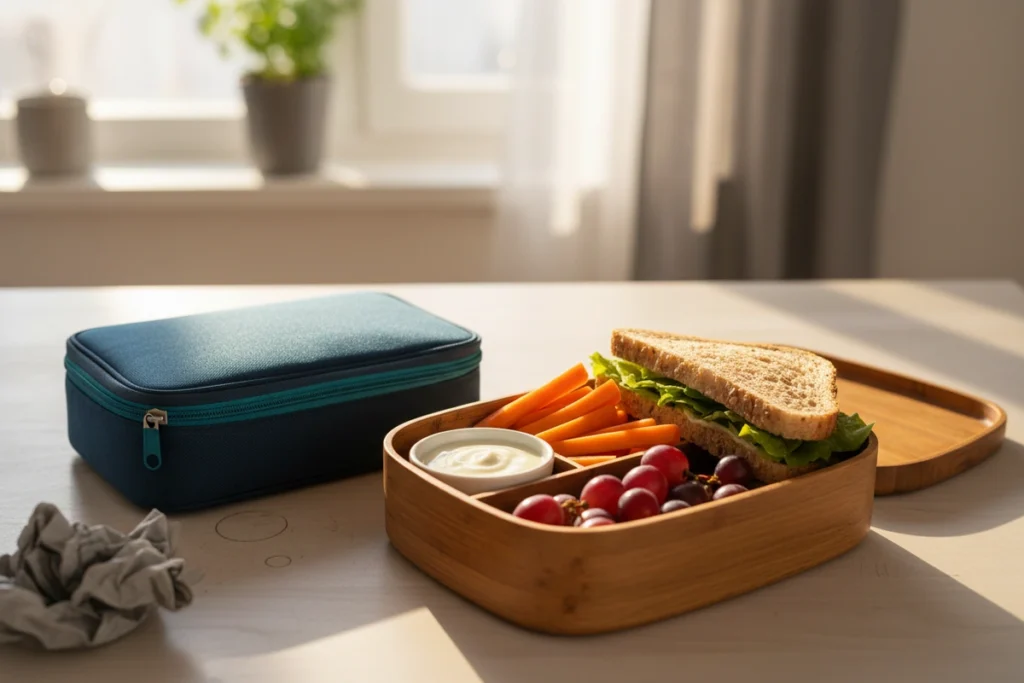
The thing that is actually lunch. A sandwich, a wrap, pasta salad, a pot of last night’s dinner, crackers with things to build on them. You need about five, rotating, and five is enough for a fortnight without anyone noticing a pattern.
The crunch
Something raw that survives four hours in a bag. Carrot sticks, cucumber, peppers, sugar snap peas. Its job is partly to be a vegetable and partly to break up a box that is otherwise entirely soft, which is what makes a lunch look unappealing when it is opened at midday.
The fruit
Whatever is in season and does not bruise between the kitchen and the classroom. Grapes, satsumas, apple slices if they are going to be eaten within the hour. This is the slot with the highest return rate and it is worth asking which fruit actually comes back empty.
The safety net
Small, familiar, and unchanging. A yoghurt, a cereal bar, a few crackers, the same one every day.
This is the slot that looks like giving up and is doing the most work. On the day the anchor is wrong — and there will be days — this is what means the box comes back empty rather than a child eating nothing until four o’clock. Its whole value is that it never changes.
The prompt
Rule two is where the time saving lives
Two of the five anchors coming from last night’s dinner is what turns this from a second cooking job into an assembly job.
A portion of pasta set aside before it goes on the table, some extra roast chicken, a few more sausages than needed. Thirty seconds at dinner, and a lunch already made. Households that plan lunches separately from dinners are cooking twice, and it is the main reason packed lunches feel disproportionate to what they are.
This works best when the dinner plan and the lunch plan are made together — the same principle as a dinner rotation, and worth asking for in the same sitting.
What comes back uneaten is the real data
For the first fortnight, look in the box at the end of the day and note what came home. Not to say anything about it — just to know.
Two weeks of that tells you which anchor is not really working, which fruit is decorative, and whether the crunch slot is being eaten at all. Then you replace one item rather than rebuilding the system, and the system gets better instead of getting abandoned.
Most lunchbox systems fail because they are judged as a whole. One anchor being wrong is not the formula failing, and swapping that one anchor is a two-minute job. If refusals are broader than lunch, the picky eater rotation is the wider version of this.
The Sunday ten minutes
Wash and cut the crunch for the whole week, portion the safety nets into a box the children can reach, and decide which two dinners are producing lunches. On the evenings that also have an activity in them, four dinner shapes survive the twenty minutes between coming in and going back out.
That is about ten minutes and it takes each weekday morning down to roughly three. Across a term it is the difference between packed lunches being a background task and being the thing that makes everybody late.
The printable
The Weekly Dinner Planner has room to mark which dinners are doubling as lunches, which is the one connection that makes the whole week cheaper and faster at the same time.
Questions about packed lunches
How many different lunches do I actually need?
About five anchors. With four slots and five rotating anchors a fortnight is covered without anyone noticing a pattern, and five is a small enough number to decide once on a Sunday rather than every morning.
Why keep the same item every single day?
Because it is the safety net. On the day the anchor turns out to be wrong — and there will be days — the familiar item is what means the box comes back empty rather than a child eating nothing until four. Its value comes entirely from not changing.
How do I stop lunches being a second cooking job?
Take two of the five anchors from the night before. A portion of pasta set aside before dinner goes on the table, or extra roast chicken, costs thirty seconds and makes a lunch. Planning lunches separately from dinners is the reason they feel disproportionate.
What if they keep bringing food home?
Look in the box for a fortnight and note what came back, without saying anything about it. That tells you which single item to swap. Most systems get abandoned because one wrong anchor is read as the whole formula failing.
How do I handle school food rules?
Put them in the prompt explicitly — nut free, no sweets, no fridge, whatever applies — and add that nothing should appear as a hidden ingredient either. Rules stated once at the top produce a system you do not have to check every morning.
Keep going
-

Why Your AI Meal Plans Get Repetitive by Week Two (And the Fix)
Chicken again. Four reasons the same meals keep coming back, three of which are things you control, and what to change in the prompt for each.
-
Back-to-School Dinner Sprint: 20-Minute Meals for Activity Nights
The constraint on an activity night is never the cooking. It is the twenty minutes between coming in and going back out, and four dinner shapes survive it.
-
AI Meal Plans for Picky Eaters (The Rotation That Ends Dinner Fights)
Four accommodations that make dinner workable, and the one that is about the adults rather than the child. Plus the prompt that builds a week around them.