Meal Prep Sundays, Planned by AI: The 90-Minute Session
What’s in this guide
Most meal prep advice is a list of things to cook. The list is the easy part. What makes a session take three hours instead of ninety minutes is the order, and specifically whether the oven is working while you are.
Thirty-five of the ninety minutes are unattended. Everything else has to be arranged around that block, and a plan that ignores it produces a session where you chop for forty minutes and then stand watching a tray.
What a prep session is actually for
Not finished meals in boxes. That version works for about two weeks and then stops, because eating the same assembled dinner four nights running is grim by Wednesday however good it was on Sunday.
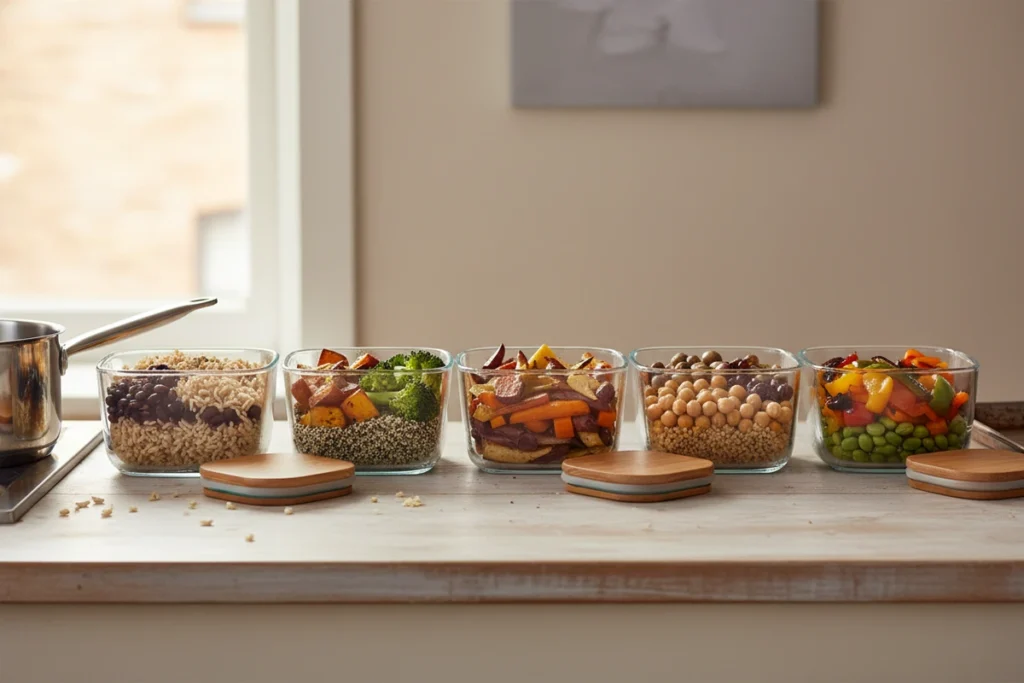
What survives is components. A tray of roasted vegetables, a pot of grains, a batch of something saucy, a few things washed and chopped. Those combine into different dinners across the week, and the deciding is still removed because the work is done.
Ask for components and you get a system. Ask for meals and you get four identical boxes.
The prompt
Rule four is the one that gets broken
A plan will cheerfully put three trays in a one-shelf oven and four pans on two rings, because it is planning food rather than a kitchen. You find out at minute 25, holding a tray, with nowhere to put it.
Saying how much oven and hob you have, and asking it to check the timeline against those before answering, catches almost all of it. It is worth reading the timeline once with only that question in mind before you start.
Cooling is not free
Rule three exists because every prep plan on the internet ends at pack into containers, as though that happens instantly.
Hot food packed straight into containers sweats, goes soft, and shortens how long it keeps. It also warms the fridge. The last fifteen minutes are cooling and packing, and building them into the timeline is the difference between a session that ends at 90 minutes and one that has a tail of jobs you do while wanting to stop.
Cooked rice is the one to be careful with: cool it quickly, get it into the fridge, and use it within a day or two. A session is also the easiest place to fix a protein-light week, which asking per meal rather than per day makes checkable.
The five-dinner list at the end
This is the instruction that stops a prep session becoming a fridge full of ingredients nobody knows what to do with on Wednesday. If the surplus is going further out than Wednesday, the freezer starter kit is the same afternoon aimed at a drawer instead.
Roasted vegetables, grains and a sauce are three components and about five dinners, but only if somebody has said out loud what those five are. Stick the list on the fridge next to the plan. The prep was the expensive part; the list is what makes it pay.
Ninety minutes is a target, not a first result
The first session will run over. That is not the plan failing — it is the same first-week cost as a first week of planning, and it comes from not knowing where anything is in your own kitchen while following someone else’s order of operations.
The second is faster and the third is roughly 90 minutes. If it is still two hours by the fourth, the session is too big. Cut a component rather than cooking faster — three components done calmly beat five done at speed and abandoned in a fortnight.
The printable
The Weekly Dinner Planner takes the five assembled dinners straight onto its seven lines, which is the whole week written down in the time it takes the last tray to cool.
Questions about prep sessions
Should I prep finished meals or components?
Components, in almost every case. Finished meals in boxes work for about two weeks and then stop, because four identical dinners in a row is grim by Wednesday. Roasted vegetables, grains and a sauce recombine into five different dinners and remove the same amount of deciding.
Why does my session always take longer than planned?
Usually because the oven started late. Thirty-five of the ninety minutes are meant to be unattended cooking, so anything that goes in at minute 50 pushes the whole session out. Asking for a minute-by-minute timeline rather than a list of recipes fixes most of it.
How long does prepped food actually keep?
Ask for four days and have it flag anything that does not manage it, which is what rule five is for. Cooked rice is the one to watch — cool it quickly, refrigerate it, and use it within a day or two rather than assuming it lasts the week.
What if I only have one oven shelf?
Say so in the prompt, and count honestly — an oven whose top shelf burns things is a one-shelf oven for planning. Without that constraint you will get a timeline with three trays in it and discover the problem at minute 25 holding one of them.
Is 90 minutes realistic the first time?
No. The first session usually runs over, because you are following someone else’s order in your own kitchen. The second is faster and the third is about right. If it is still two hours by the fourth, cut a component rather than trying to move quicker.
Keep going
-
Why Your AI Meal Plans Get Repetitive by Week Two (And the Fix)
Chicken again. Four reasons the same meals keep coming back, three of which are things you control, and what to change in the prompt for each.
-
Back-to-School Dinner Sprint: 20-Minute Meals for Activity Nights
The constraint on an activity night is never the cooking. It is the twenty minutes between coming in and going back out, and four dinner shapes survive it.
-
AI Meal Plans for Picky Eaters (The Rotation That Ends Dinner Fights)
Four accommodations that make dinner workable, and the one that is about the adults rather than the child. Plus the prompt that builds a week around them.