The Evening Routine That Makes Tomorrow Easier
What’s in this guide
The short version: almost everything that makes a morning bad was decided the night before. Ten minutes, four small things, none of them self-improvement — just the decisions moved to a time when you are able to make them well.
The evening routine does more for a morning than the morning routine does, and gets a fraction of the attention. The productivity guide covers where it fits; this is the routine itself.
Why the evening is worth more than the morning
A morning decision is made under time pressure by somebody who has just woken up. The same decision made at nine the night before is made calmly, with the information already in view, by somebody who can see the whole of tomorrow.
Nothing in the list below takes longer than three minutes. What they have in common is that each one removes a decision from a moment that cannot afford one.
One — put tomorrow’s obstacle by the door
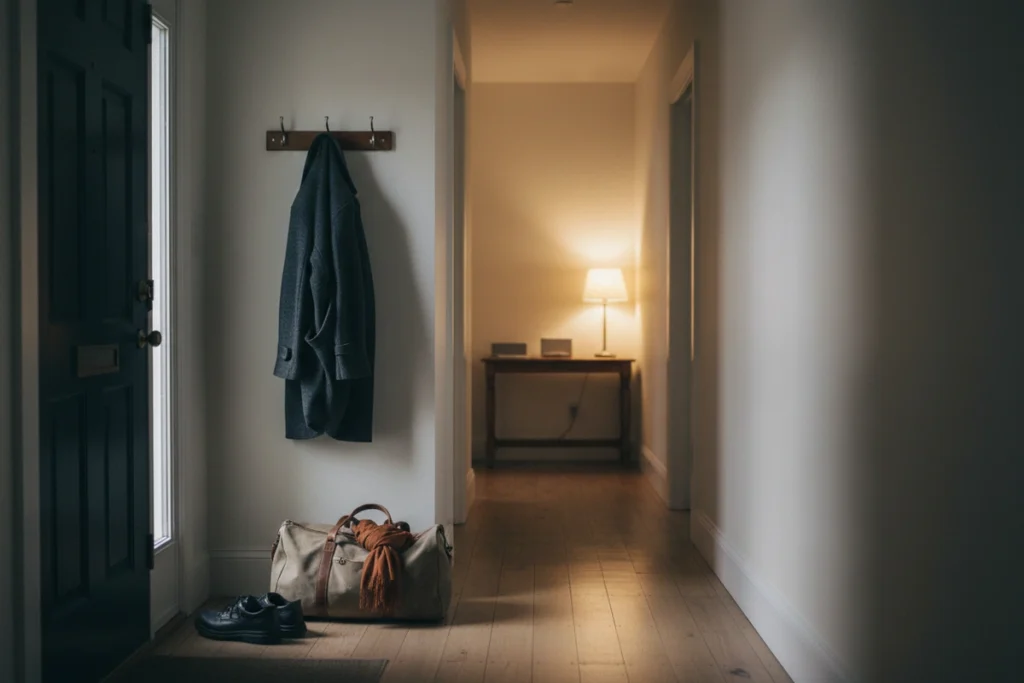
Whatever tomorrow needs that is not already where you will be: the bag, the form, the thing to return, the kit for the class. By the door, tonight.
The point is not tidiness. It is that finding something at 8:10am costs four minutes and a mood, and finding it at 9pm costs forty seconds and nothing at all. The door is the location because the door is the last place you can still fix a mistake.
Two — decide breakfast and lunch
Not make them. Decide them, out loud or on paper, so that nobody is standing in front of a cupboard at half seven making a choice.
If lunches are a running battle, deciding is a third of the job and the lunchbox formula removes the other two thirds by having decided the shape once rather than each night.
Three — one surface, two minutes
Pick the surface that sets the tone for your morning — usually the kitchen worktop or the table — and clear only that one. Set a timer if you are the kind of person who will otherwise clean the kitchen.
Waking up to one clear surface changes the first ten minutes of a day out of proportion to the effort. Waking to a whole clean house would be better and is not available on a Tuesday night, which is exactly why the routine specifies one surface.
Four — write down the one thing
The single thing that has to happen tomorrow. One line, on paper, where you will see it.
This is the closest thing to planning in the routine and it exists mostly to stop tomorrow being decided by whatever arrives first. A day with one named thing survives a chaotic morning. A day with an unspoken sense that there was something important does not.
It also does a second job, which is the one people notice: written down, the thing stops being rehearsed in bed.
The prompt
Use it once, to design your four. After that the routine is four things you know, not a prompt you run nightly.
Where to put it
Attach it to something that already ends your evening — the dishwasher going on, the last cup of tea, the moment the television goes off. Same principle as the morning version: an anchor that happens anyway beats a time you have to remember.
Avoid attaching it to going to bed. By then the routine competes with sleep, and it loses — correctly.
What this will not fix
Mornings that are hard because there is genuinely not enough time in them. If four people need the bathroom in twenty minutes, no evening routine creates a fifth. What it can do is make sure none of those twenty minutes goes on finding a shoe or deciding about toast.
If the crunch is specifically getting everyone out of the door, that morning has its own guide and it starts from the timings rather than the routine.
The printable
The Weekly Planner has a line for tomorrow’s one thing, which is the item most worth having on paper rather than in your head at eleven at night.
Questions about evening routines
Why is the evening better than the morning for this?
Because the same decision is made calmly at nine at night and under pressure at half seven by somebody who has just woken up. Nothing in the routine takes more than three minutes; what they share is removing a decision from a moment that cannot afford one.
Is this a wind-down routine?
No, and mixing the two is why evening routines get abandoned. This one is logistics — bag by the door, meals decided, one surface, one line written down. Skincare, journalling and a screen curfew are a different and far more ambitious project.
When in the evening should I do it?
Attached to something that already ends your evening: the dishwasher going on, the last cup of tea, the television going off. Do not attach it to going to bed, because then it competes with sleep and loses, which is the right outcome.
What if I only have two minutes?
Do the one that fixes your worst morning problem — for most households that is putting tomorrow’s things by the door. Decide which one that is in advance rather than choosing at the time, which is the same reason the morning routine has a two-minute version.
Will this fix a genuinely rushed morning?
Only partly. If four people need the bathroom in twenty minutes, no evening routine creates a fifth. What it does is make sure none of those twenty minutes is spent finding a shoe or deciding about breakfast, which is usually more of them than you would guess.
Keep going
-

Time Blocking with Kids at Home (The Interruptible Version)
Plan for the interruption instead of around it. Work that survives being put down, and the one block worth actually defending.
-

Plan Your Ideal Week with AI: Time Blocking for Beginners
Start from the week you actually had, not the one you want. Block the shape of the day rather than the hours, and only three blocks are yours.
-
Break a Goal into a 12-Week Plan with One Prompt
Twelve weeks is long enough to finish something and short enough to see the end. The prompt, and the two weeks you must leave empty.